


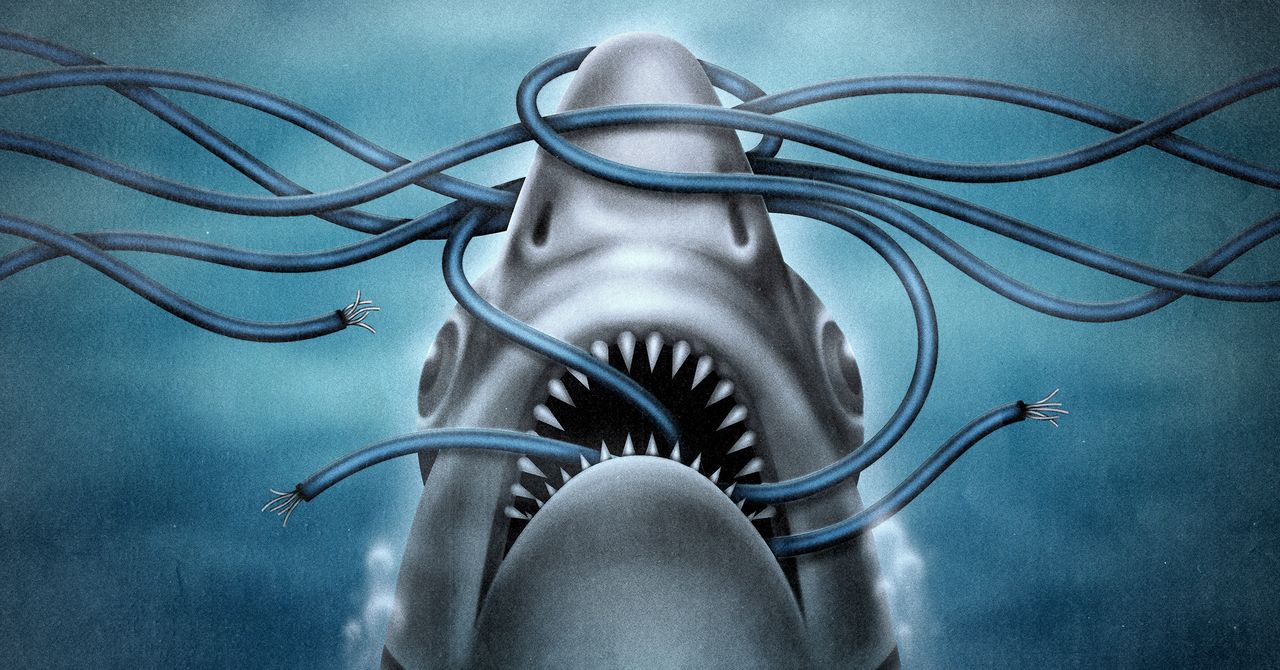
Sharks are innocent. Or at least they’re not eating the internet. As a family of cartilaginous fish, sharks are collectively not guilty of most, if not all, charges of biting, chomping, chewing, or otherwise attacking the underwater network of fiber-optic cables. The people who build and maintain the nearly 600 subsea cables that carry almost all of our intercontinental traffic—supporting just about every swipe, tap, Zoom, and doomscroll anywhere on the planet—have a love-hate relationship with this myth, which has persisted for decades. They might even hate that I’m starting this piece with it.
If a cable is suspended over the seabed, a shark might gum it as it explores. Sometimes they’ll lunge for a cable that’s being pulled out of the water. But for a shark to actually bite a cable, you’d have to wrap it in fish, much as you’d hide a pill in a hunk of cheese for the dog. Rats can be a threat on land, because their incisors never stop growing, so they like to file them down on semisoft cables. But nobody ever asks about rats, maybe because, as a friend of mine pointed out, “sharks make you cool, but rats sound like you have a problem.”
Sometimes people ask about satellites or, especially in Sweden (where I live), about alleged sabotage in the Baltic Sea. But historically, shark bites have commanded the most attention. The myth began nearly 40 years ago, with the development of a subsea fiber-optic cable known as TAT-8. TAT-8 practically invented the concept of an internet cable, and now that it’s ready for retirement, I spent time with the offshore workers, crew members, and engineers who are in the process of pulling it off the seabed. That’s the real story of subsea cables—not sabotage or sharks, but the humans who take care of the physical stuff that keeps all of our digital communication flowing.
Fiber-optic transmission is a near-magical way of carrying information by pulses of light. Most people don’t even think about how quickly we’ve accepted instantaneous communication as normal, even those of us who can remember when an international phone call had to be booked in advance. The more people I meet in this industry, in this network of networks of people and things, the more insulting it sounds to hear that “we” only notice it when it breaks. (Who is this “we,” I always want to know?) Billions of people are able to walk around not noticing this infrastructure because of the daily work of a few thousand people, sometimes at sea, other times buried under piles of permits, surveys, and purchase orders for thousands of kilometers of cables that will join the millions of kilometers of cables on the seabed that ensure that our planet is continuously being hugged by light.
I also need to clear up something else. Most people call them “internet cables,” but technically, fiber-optic transmission was developed for telephone calls. One of the people involved was an English scientist named Alec Reeves, who also spent his time working on psychokinesis and telepathy. With fiber, voices become light, pulsate across spiderweb-thin strings of glass, and become voices again in your handset on the other end. Maybe there isn’t that much of a conceptual leap between that and moving things with your mind.
TAT is short for Trans-Atlantic Telephone, and TAT-8—built by AT&T, British Telecom, and France Telecom—was the eighth transoceanic system across the Atlantic. It was the first to use optical fibers to transmit traffic between Europe and the United States. Fiber optics for communication had only been worked out in theory in the 1960s, and terrestrial cables were first used in the 1970s. But using this technology to span continents was practically tantamount to human galactic expansion.
When TAT-8 went into service on December 14, 1988, the science fiction writer Isaac Asimov spoke on video link from New York to audiences in Paris and London: “Welcome everyone to this historic transatlantic crossing,” he said, “this maiden voyage across the sea on a beam of light.” AT&T made a TV ad, in which an earnest voice-over promised a “worldwide intelligent network” where people could send information in any format to anyone they want. Cue the montage of telephone operators: “This is the AT&T operator. You have a call booked for Poland?” “I have your call to Russia.” “What city in Cuba are you calling?” If they were looking to inspire viewers, it wasn’t with the promise of the internet, which was still too niche for most of us to comprehend, but with the end of the Cold War.
The Big Story,Business,Business / Big Tech,Things Fall Apartlongreads,internet,oceans,cables,infrastructure,recycling,things fall apart#Goodbye #Undersea #Cable #Global #Internet1771847102
