

Subscribe to Updates

    Get the latest creative news from FooBar about art, design and business.

    What's Hot

    Trump Imposes New Tariffs to Sidestep Supreme Court Ruling

    February 21, 2026

    Meta’s metaverse leaves virtual reality

    February 21, 2026

    The Best Mushroom Gummies on the Market, Lab-Approved (2026)

    February 21, 2026
    Facebook Twitter Instagram
    • Tech
    • Gadgets
    • Spotlight
    • Gaming
    Facebook Twitter Instagram
    iGadgets TechiGadgets Tech
    Subscribe
    • Home
    • Gadgets
    • Insights
    • Apps

      Google Uses AI Searches To Detect If Someone Is In Crisis

      April 2, 2022

      Gboard Magic Wand Button Will Covert Your Text To Emojis

      April 2, 2022

      Android 10 & Older Devices Now Getting Automatic App Permissions Reset

      April 2, 2022

      Spotify Blend Update Increases Group Sizes, Adds Celebrity Blends

      April 2, 2022

      Samsung May Improve Battery Significantly With Galaxy Watch 5

      April 2, 2022
    • Gear
    • Mobiles
      1. Tech
      2. Gadgets
      3. Insights
      4. View All

      Three NASA Rockets Dive Into the Electric Heart of the Northern Lights

      February 21, 2026

      “Ghost” 7-Foot Great White Shark Caught in the Mediterranean Sparks 160-Year Investigation

      February 20, 2026

      Scientists Discover How Psychedelics Turn Memory Into Hallucinations

      February 20, 2026

      Scientists Warn: 5,000-Year-Old Ice Cave Bacteria Resistant to Modern Antibiotics

      February 20, 2026

      March Update May Have Weakened The Haptics For Pixel 6 Users

      April 2, 2022

      Project 'Diamond' Is The Galaxy S23, Not A Rollable Smartphone

      April 2, 2022

      The At A Glance Widget Is More Useful After March Update

      April 2, 2022

      Pre-Order The OnePlus 10 Pro For Just $1 In The US

      April 2, 2022

      Trump Imposes New Tariffs to Sidestep Supreme Court Ruling

      February 21, 2026

      The Best Mushroom Gummies on the Market, Lab-Approved (2026)

      February 21, 2026

      A Galaxy Composed Almost Entirely of Dark Matter Has Been Confirmed

      February 21, 2026

      The Supreme Court’s Tariff Ruling Won’t Bring Car Prices Back to Earth

      February 21, 2026

      Latest Huawei Mobiles P50 and P50 Pro Feature Kirin Chips

      January 15, 2021

      Samsung Galaxy M62 Benchmarked with Galaxy Note10’s Chipset

      January 15, 2021
      9.1

      Review: T-Mobile Winning 5G Race Around the World

      January 15, 2021
      8.9

      Samsung Galaxy S21 Ultra Review: the New King of Android Phones

      January 15, 2021
    • Computing
    iGadgets TechiGadgets Tech
    Home»Insights»A Galaxy Composed Almost Entirely of Dark Matter Has Been Confirmed
    Insights

    A Galaxy Composed Almost Entirely of Dark Matter Has Been Confirmed

    adminBy adminFebruary 21, 2026No Comments3 Mins Read
    Facebook Twitter Pinterest LinkedIn Tumblr Email
    A Galaxy Composed Almost Entirely of Dark Matter Has Been Confirmed
    Share
    Facebook Twitter LinkedIn Pinterest Email

    Astronomers have just identified what appears to be a cosmic anomaly: a faint galaxy with so few visible stars that, according to calculations, as much as 99.9 percent of its mass is dark matter. The remaining 0.1 percent is conventional matter.

    This galaxy, located about 300 million light-years away, is practically invisible. Only four globular clusters, small concentrations of stars that look like isolated neighborhoods in the middle of the void, stand out. For years, these star collections in the Perseus cluster were considered independent objects.

    Cúmulos globulares en el Cúmulo de Perseo.

    Candidate Dark Galaxy-2 is only visible through four globular clusters that contribute to 16 percent of its total brightness. Scientists believe 99.9 percent of this galaxy is dark matter.

    NASA/ESA

    Now, after an exhaustive analysis, a study published in The Astrophysical Journal Letters presents solid evidence that these globular clusters are part of the same galaxy dominated by dark matter. Tentatively named CDG-2 (Candidate Dark Galaxy-2), it is the first galaxy to be detected only by its brightest fragments.

    The authors pooled data from the Hubble, Euclid, and Subaru telescopes, three of the most powerful observatories available. The combined readings reveal an extremely faint glow around the four globular clusters. This residual light is a clear sign of an underlying galaxy so dim that the three telescopes missed it on their own.

    More Than Meets the Eye

    Preliminary analysis indicates that CDG-2 has a total luminosity equivalent to about 6 million suns, with the four globular clusters contributing about 16 percent of that brightness, an unusually large share. This distribution suggests that, despite its low light, the galaxy is a gravitationally bound system, implying a particularly dense dark matter halo. Astronomers estimate that this invisible structure accounts for between 99.94 to 99.98 percent of CDG-2’s total mass.

    According to current models, dark matter constitutes roughly 27 percent of the universe’s total energy density and about 85 percent of its matter. Although the exact nature of what makes up dark matter is still unclear, because it neither emits nor reflects light, scientists infer its existence from its gravitational effects on radiation, visible matter, and the large-scale structure of the cosmos.

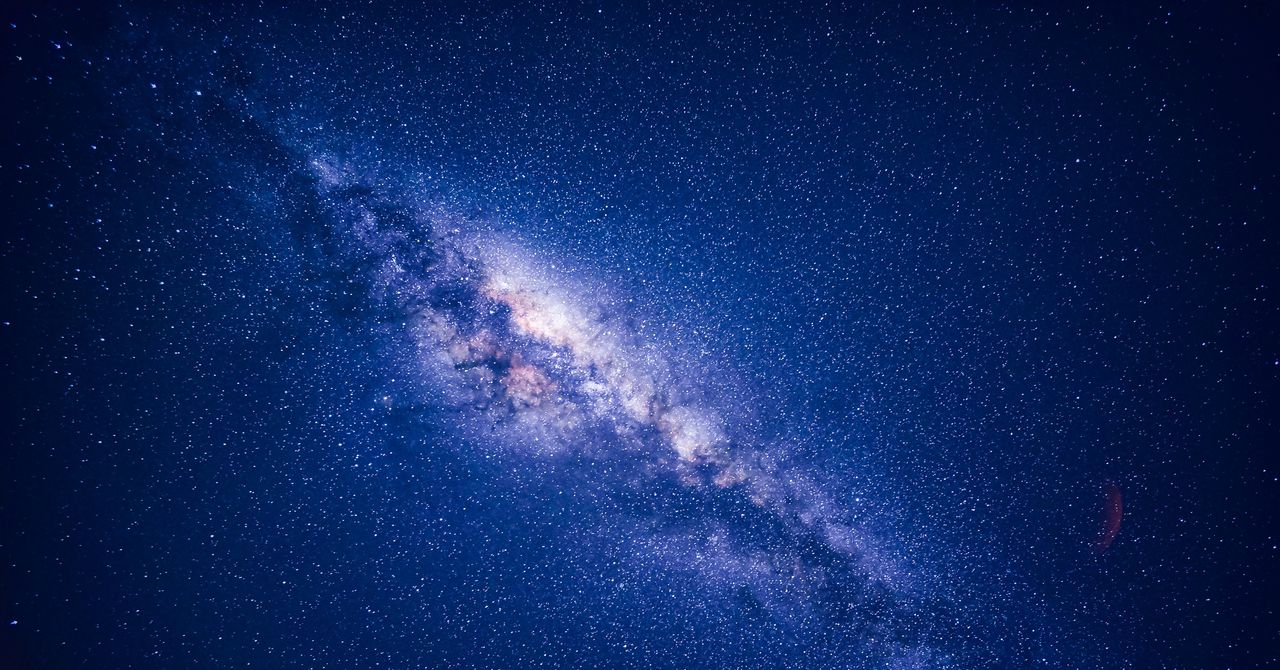
    Dark matter is so pervasive throughout galaxies that its presence explains the stability and motion of stars in systems such as the Milky Way. For example, current models indicate that our galaxy is embedded in a halo composed of about 90 percent dark matter.

    However, the case of CDG-2 is extreme: a galaxy with almost no stars, surrounded almost entirely by an invisible halo. These types of systems, so-called “dark galaxies,” are beginning to appear in astronomical records. Beyond their rarity, scientists value them because they serve as natural laboratories for exploring the nature of dark matter and testing current models of galaxy formation.

    This story originally appeared on WIRED en Español and has been translated from Spanish.

    Science,Science / Space,Rarely Seendark matter,space,astronomy,telescopes,stars#Galaxy #Composed #Dark #Matter #Confirmed1771638590

    astronomy dark matter Space Stars telescopes
    Share. Facebook Twitter Pinterest LinkedIn Tumblr Email
    admin
    • Website
    • Tumblr

    Related Posts

    Trump Imposes New Tariffs to Sidestep Supreme Court Ruling

    February 21, 2026

    The Best Mushroom Gummies on the Market, Lab-Approved (2026)

    February 21, 2026

    The Supreme Court’s Tariff Ruling Won’t Bring Car Prices Back to Earth

    February 21, 2026
    Add A Comment

    Leave A Reply Cancel Reply

    Editors Picks

    FedEx tests how far AI can go in tracking and returns management

    February 3, 2026

    McKinsey tests AI chatbot in early stages of graduate recruitment

    January 15, 2026

    Bosch’s €2.9 billion AI investment and shifting manufacturing priorities

    January 8, 2026
    8.5

    Apple Planning Big Mac Redesign and Half-Sized Old Mac

    January 5, 2021
    Top Reviews
    9.1

    Review: T-Mobile Winning 5G Race Around the World

    By admin
    8.9

    Samsung Galaxy S21 Ultra Review: the New King of Android Phones

    By admin
    8.9

    Xiaomi Mi 10: New Variant with Snapdragon 870 Review

    By admin
    Advertisement
    Demo
    iGadgets Tech
    Facebook Twitter Instagram Pinterest Vimeo YouTube
    • Home
    • Tech
    • Gadgets
    • Mobiles
    • Our Authors
    © 2026 ThemeSphere. Designed by WPfastworld.

    Type above and press Enter to search. Press Esc to cancel.