


Miniaturization has long been a challenge in the history of robotics.
While engineers have made great strides in the miniaturization of electronics in the past few decades, builders of miniature autonomous robots have not been able to meet the goal of getting them under 1 millimeter in size. This is because small arms and legs are fragile and difficult to manufacture. Above all, the circumstances of the laws of physics change in the microscopic world. Instead of gravity and inertia, drag and viscosity become dominant.
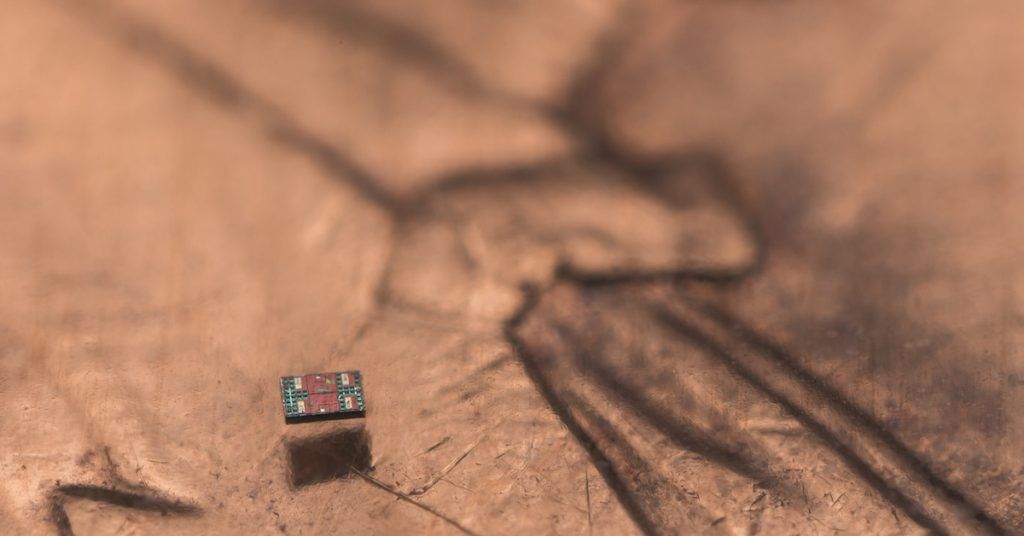
Against this backdrop, researchers in the US have announced the results of a study that accomplishes a 40-year-old challenge. A team of researchers from the University of Pennsylvania and the University of Michigan has developed a new robot that is smaller than a grain of salt, measuring only 200 x 300 x 50 micrometers. At 0.3 mm on its longest side, that’s far below the 1-mm threshold. Yet it can sense its surroundings, make decisions on its own, and swim and move in water.

Moreover, it operates completely autonomously and is not dependent on any external controls such as wires or magnetic fields. The production cost is said to be as low as 1 cent per unit.
“We have succeeded in miniaturizing an autonomous robot to 1/10,000th the size of a conventional robot,” says Mark Miskin, one of the researchers, who’s an assistant professor of electrical systems engineering at the University of Pennsylvania. “This opens up a whole new scale for programmable robots.”
The Electric Slide
The propulsion system developed by Miskin and his team is a breakthrough in conventional robotics. Fish and other large aquatic organisms move forward due to the reaction of water pushing backward, in accordance with the third law of motion in Newtonian mechanics. But pushing water on a microscopic scale is like pushing sludgy tar. The viscosity of the water is so great that small arms and legs can never compete with it.
So the researchers adopted a completely new approach. Instead of swimming by moving parts of its body, the new robot moves by generating an electric field around it and gently pushing charged particles in the liquid. The robot exploits the phenomenon that moving charged particles drag nearby water molecules, creating a water current around the robot. It is as if the robot itself is not moving, but the ocean or river is moving.

Gear,Gear / Gear News and Events,Chips Ahoyrobots,robotics,chips,computers#Autonomous #Aquatic #Robot #Smaller #Grain #Salt1769277223
